“Consequently, you are no longer foreigners and strangers, but fellow citizens with God’s people and also members of his household.” – Ephesians 2:19
Think about the last time you walked into a room and wondered whether you belonged. A new city, a new school, a meeting, or even a church gathering where everyone seemed to know the rules except you. Many of us know that feeling well, and some of us carry it every day because of our appearance, our accent, our passport, our faith or the place we come from.
Paul wrote these words to people who had been told, in a thousand ways, that they were outsiders. He did not say, “Try harder to fit in.” He said something far bigger: you already belong. You are not a guest in God’s house but a member of the family, and not a visitor in God’s city but a citizen.
This is where our identity begins: not with what we achieve or what others say about us, but with a welcome we did not earn. And a welcome like that changes how we live together. If we are all members of one household, then no one’s voice is optional, and no one’s seat at the table is a favour granted by someone else. At its best, democracy is a human attempt to live this out: a space where every person is seen, counted and heard.
So… Who are we? And who gets to decide?… Democracy is under strain: polarisation, disinformation, distrust in institutions and shrinking space for civil society leave many young people wondering whether their voice makes any difference. At the same time, identity (national, cultural, linguistic, religious, gender) can be a source of deep belonging, but also a reason for exclusion and division. As young Christians, we cannot watch from the sidelines.
This year, WSCF Europe has been living these questions together: at the Mission Diversity Winter School, which explored discrimination and inclusion practices in church spaces; in the Youth in 4D: Discover, Defend and Drive Democracy gatherings in Oslo, Torre Pellice and Prague; and at the Democracy Summer School in Paris. Now we would like to open the pages of Mozaik to what those encounters, and your own everyday life, have been stirring in you.
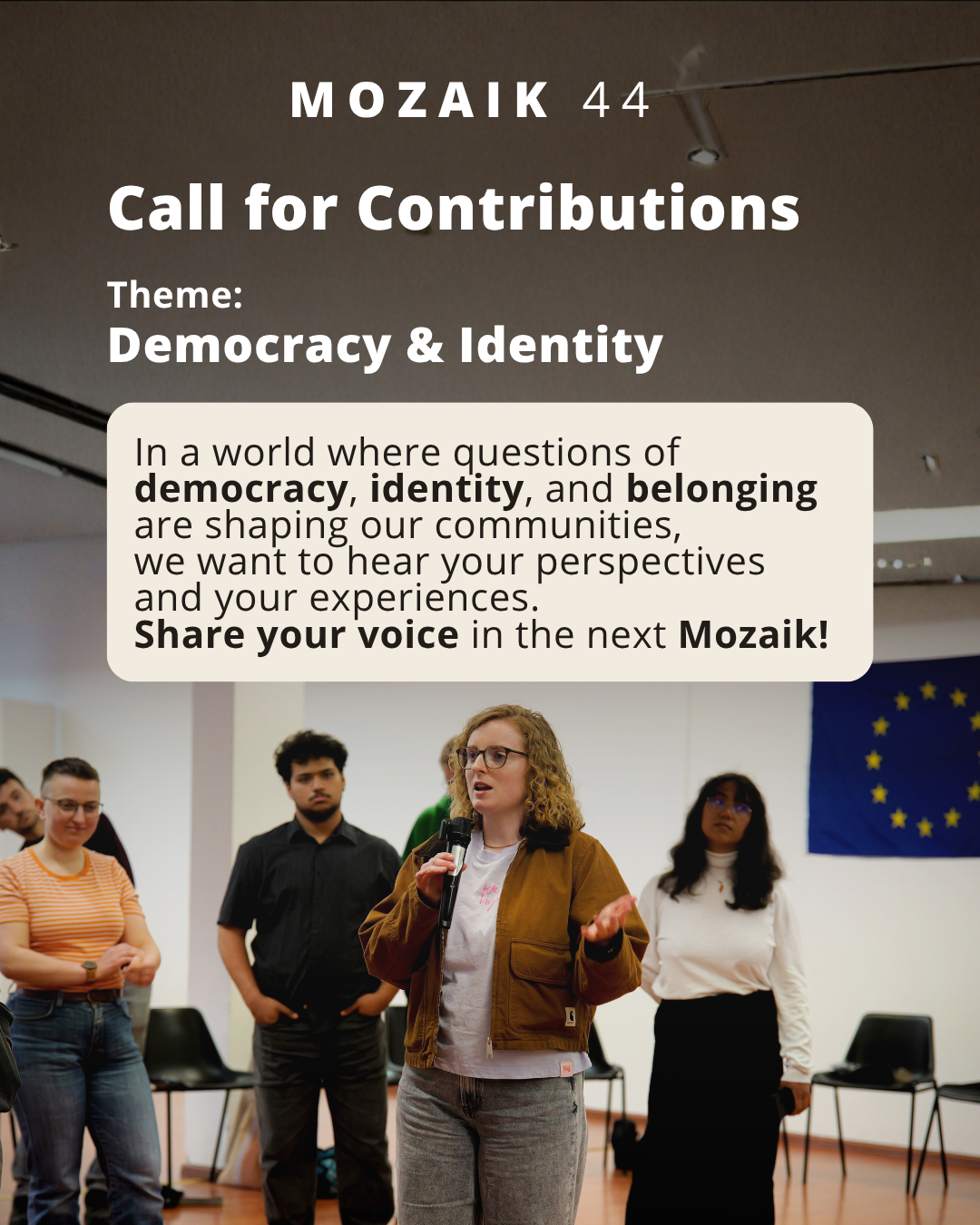
Mozaik 44 invites you, wherever you are in the world, to share your stories, insights and creative expressions on Democracy & Identity. You do not need to be an expert, a politician or a theologian. Whether you are a student, an activist, a youth worker, a first-time voter, a migrant, a member of a minority, an artist or simply someone who cares, your perspective matters, and we want to read it.
We are looking for:
- Articles (up to 2,000 words)
- Personal stories and reflections
- Poems, prayers or liturgies
- Visual art, photography and design (PNG or JPG format)
- Other creative expressions (e.g. interviews, infographics, multimedia ideas)
Send your contributions or questions to Mozaik’s Editor-in-Chief, Laura Gomez, at mozaik@wscf-europe.org
Style guidelines for articles:
- British English spelling
- Word limit: maximum 2,000 words
- Please use APA (7th edition) referencing style for any citations and include a full reference list at the end of your text.
Guidelines for images:
- PNG or JPG format – A full-page image should be around 1748 × 2480 pixels at 300 dpi. (If the image will cover only half a page, it can be proportionally smaller, but still at 300 dpi)
- For the small photos of the authors (next to the articles) 150 dpi or around 500 × 500 pixels is sufficient. Best option: half-length portrait with natural light.
In addition to your contribution, please send a short bio (no more than 50 words) and a high-quality picture of yourself (if you are comfortable with it)
Not sure what to share? Here are some possible angles:
- Faith and citizenship: What does being a Christian in a democratic society mean to you?
- Identity and belonging: Stories of migration, minorities, language, culture and what it means to feel at home.
- Democracy under pressure: Disinformation, polarisation, populism, shrinking civic space and how young people respond.
- Youth participation: What does meaningful youth participation look like in your church, community or society?
- Diversity and inclusion: How can we create spaces where different voices are genuinely heard?
- Justice and participation: Who is included in decision-making, and who is still left out?
- The Church in the public square: What is the role of churches and Christian communities in strengthening (or weakening) democratic life?
- Bridges across difference: Intercultural and interfaith encounters that make plural societies possible.
- Your story: What has your own experience taught you about democracy, identity, belonging or community?
This is a space where we can:
- Listen to voices that are too often left out
- Explore how faith and democratic participation can nourish each other
- Celebrate identities without turning them into walls
- Build networks of young people committed to justice and dialogue across cultures and contexts
You do not need to have all the answers. We are not looking for perfect answers or academic essays. Bring us your thoughtful questions, your experiences, your creativity and your voice. There is a seat here with your name on it, and we can’t wait to hear what you want to say to the world.
