
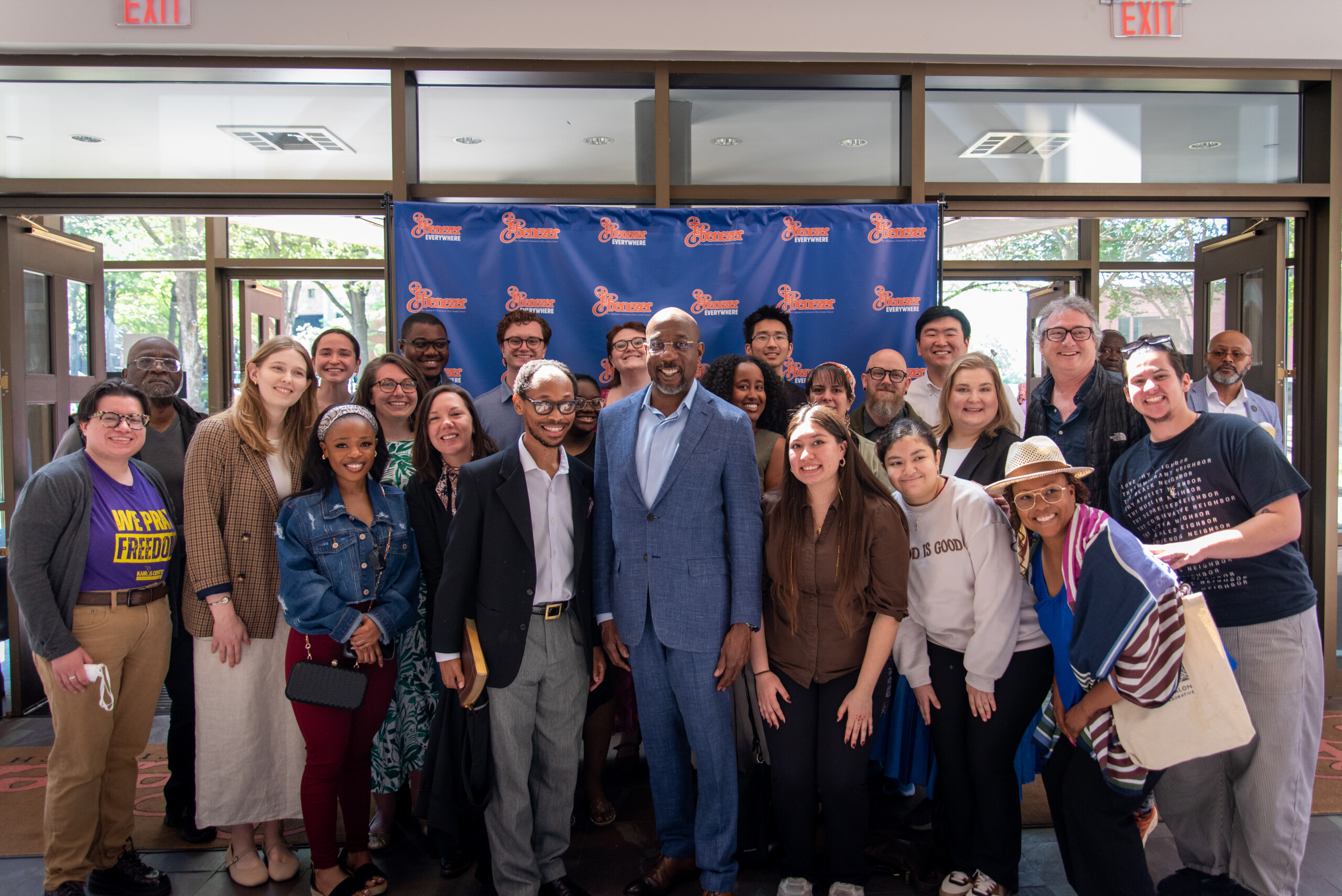
Our ExCo member Jonna recently traveled to an event hosted by WSCF-US and reflects on her experience:
A few weeks ago, I had the honour of attending the National Conference of our sibling organisation, WSCF-US. The theme of the conference was “Study War No More” and it took place on the campus of Columbia Theological Seminary in the Atlanta metropolitan area. At first, when I asked myself what a culture of war means, my thoughts went immediately to militarisation: armies, weapons, and geopolitical conflicts. But over the course of the weekend, my understanding began to change. A culture of war runs much deeper. It is not only about institutions or states, it is also about the ways we relate to one another in everyday life.
During the conference, we visited Ebenezer Baptist Church, where Martin Luther King Jr. once served as pastor. He is one of the most well-known leaders of non-violent resistance in the Black civil rights movement, and his legacy is still visible in the city. His work was not only political but also deeply rooted in faith: a vision of justice based on dignity, connection, and love. I also visited the National Center for Civil and Human Rights. One part of the exhibition stayed with me. It was a simulation of the lunch counter sit-ins. Visitors sit at a counter meant for white people and hear insults and threats through headphones. The experience gives a small sense of what Black protesters went through. It was uncomfortable and powerful. It showed clearly that non-violent action does not avoid conflict – it can make it more visible.
This leads to an important question: Why does non-violent advocacy so often lead to aggressive reactions? Why does peaceful protest make some people so angry?
This dynamic is not only part of history. In Finland, even small and non-violent actions can lead to strong reactions. During Suviseurat, which is the summer convention of the Conservative Laestadianist movement, some activists have used stickers or short public messages to raise awareness. These actions are non-violent and relatively small, yet they have led to anger, quick removal of the messages, and tense encounters. Again, the reaction is often stronger than the action itself. We can see the same pattern in other contexts. For example, Greta Thurnberg speaks in a direct but non-violent way, yet she often faces personal attacks. Earlier movements show this too. During the civil rights movement, peaceful protesters were shouted at, attacked, and arrested. So it is not unusual unfortunately that peaceful protest is seen as a threat.
At the same time, non-violent resistance opens a different way of being together. It calls us into relationship, responsibility, and the recognition that our lives are already bound to one another, whether we acknowledge it or not. Cooperation is not always easy across countries, traditions, or even between two people. Yet it remains essential. In the life of WSCF, this shared work becomes visible. And for Christians, it is more than cooperation: it is a calling into communion, where Christ gathers what is divided, and holds us together with God and with one another.
We are not called to stand apart from one another, but to live as if reconciliation is possible and already beginning among us.
