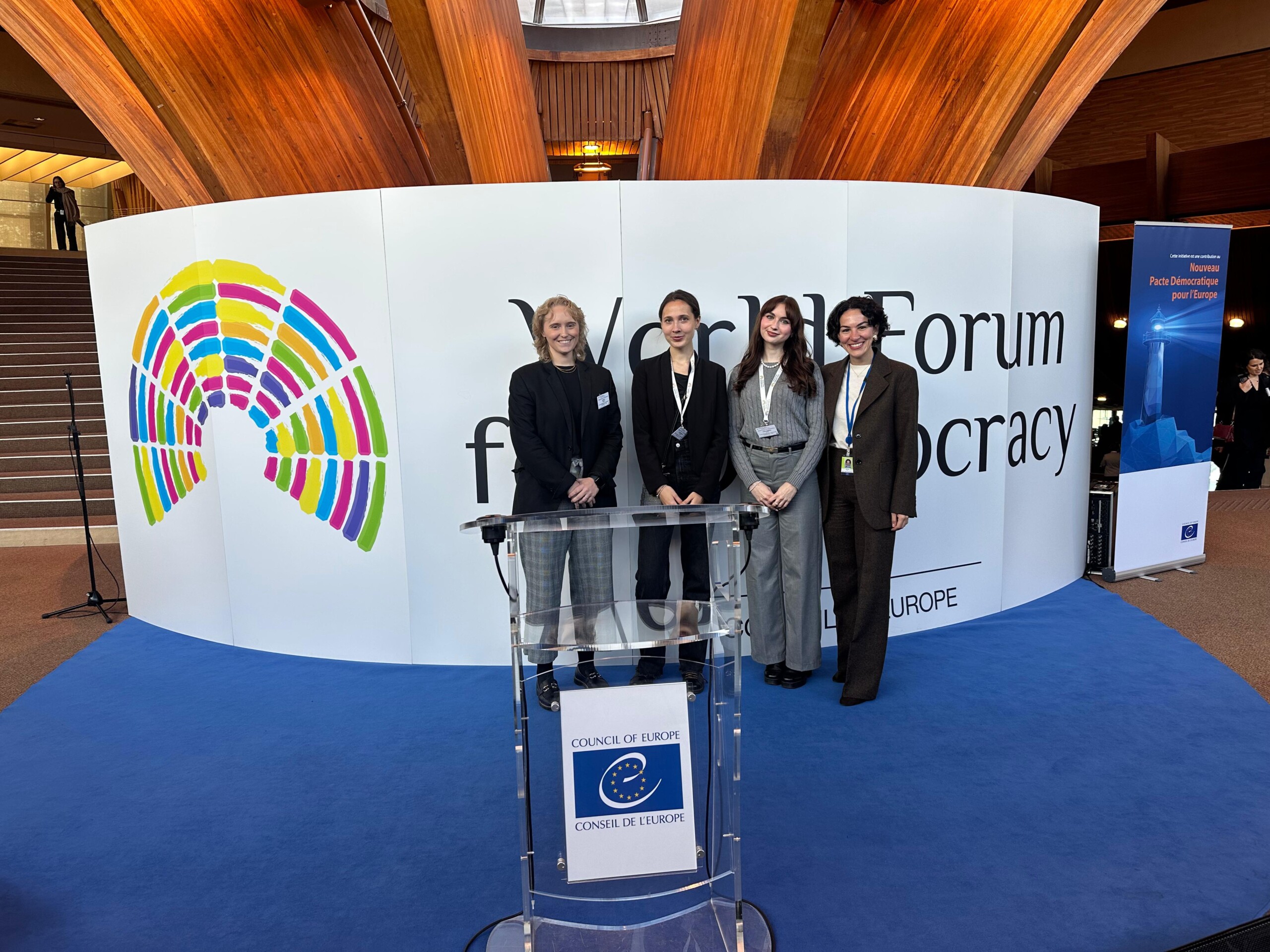
Representing WSCF-Europe, Emma Perry reflects on her experience as a member of the Conference of INGOs Youth Delegation to the World Forum for Democracy:
The 13th World Forum for Democracy took place from 5-7 November 2025 in Strasbourg, supported by the Council of Europe in partnership with the European Collectivity of Alsace, the City of Strasbourg, the Grand Est region, and the French Ministry for Europe and Foreign Affairs. The 2025 World Forum for Democracy was held under the theme “Democracy at risk: how can we revive it?” with a particular focus on the rise in distrust toward democratic institutions and processes, the primary sources of this dissatisfaction, and the consequences of withdrawal from participatory spheres for a democratic society.
The first day of the forum began with a “Time for Facts” session, held before the formal opening and plenary sessions. The moderator opened with a quote from 2021 Nobel Peace Prize laureate Maria Ressa of the Philippines, “Without facts, you can’t have truth. Without truth, you can’t have trust. Without trust, we have no shared reality, no democracy…” It is fairly safe to say that what followed was a thorough, seemingly unending onslaught of harsh facts about the state of democracy, and perceptions of democracy, in the world today.
Data from the V-Dem Institute’s Democracy Report 2025, entitled “25 Years of Autocratization: Democracy Trumped?” showed that liberal democracies have become the least common regime type in the world, a total of 29 in 2024. Nearly 3 out of 4 people in the world (72%) now live in autocracies. The number of countries moving toward authoritarianism is higher now than in the 1930s. Further investigation of the V-Dem Institute Democracy Report 2025 paints an even bleaker picture, specifically that since 2014, “the quality of democracy in democracies has declined…” with a gradual rise in electoral democracies in countries formerly categorised as liberal democracies, “while the severity of authoritarianism in autocracies has increased – a growth in the ‘worst of both worlds.”
A representative of Article 19, the leading international freedom of expression organisation, noted that freedom of expression is at its lowest point since the end of the Cold War. Only 15 per cent of the world lives in countries considered “open”. Only 4% of people, fewer than 300 million people, across just 15 countries have experienced improvements in freedom of expression over the last decade.
Following these insightful overviews, a presenter from the Pew Research Centre provided a look at citizens’ satisfaction with democracy. In June 2025, Pew Research published a report on citizens’ dissatisfaction with democracy’s functioning. It was noted that, due to the COVID-19 pandemic, the Pew Research Centre’s capacity to sample a greater range of countries was limited; thus, the report focuses primarily on 12 high-income countries. The data show that the majority of adults surveyed (64%) are dissatisfied with the way democracy is functioning in their country. However, the presenter went on to show that citizens are more satisfied with democracy’s functioning after their party wins the election. A wonderfully inspiring insight into how people discern democracy’s functionality. The one thing tying all of us disparate peoples together seems to be our shared dissatisfaction with political elites, regardless of ideology.
In my experience, discussing the state of democracy today feels a bit like verbal doomscrolling. It is relatively safe to say that the “Time for Facts” lived up to my expectations, but at least it felt like doomscrolling with a degree.
Democracy, Media, and Information Integrity
Proceeding the sobering introduction of “Time for Facts”, Plenary One examined how media transformations are influencing democracy. Quality journalism remains essential for pluralism and informed debate, yet it is weakened by financial pressure, authoritarian interference, and AI-driven manipulation. Big tech now occupies a central role in shaping public information, wielding quasi-governmental power to moderate and regulate information spaces, often without real accountability. At the same time, these platforms have given increased visibility to marginalised voices, like women and indigenous people. Several speakers underlined the duty of governments not only to respect freedom of expression but to safeguard the broader environment in which information circulates. Another concern raised is the persistent failure of mainstream media to challenge propaganda, calling for honesty regarding our expectations of media systems. It feels worth noting here that the following day, on November 6th, the New York Times published an opinion piece entitled “Did Liberal Feminism Ruin the Workplace?”
Herein, I found myself adding an additional question to a growing list of worrisome thoughts on the first day: what are we to do when the press, our so-called “fourth estate”, falls silent and fails in its role as watchdog, or even worse, what is to be done when they’ve become enablers?
Culture, Education, and Democratic Resilience
Plenary Session 2 focused on the role of culture in democratic life. The panellists discussed whether art can ever be truly apolitical and how it can reopen conversations and inform public reflection. Culture can help citizens evaluate information rather than passively consume it. Art especially pushes boundaries, challenges realities and status quos, unsettles, reminds, and reopens conversations. It can become a quiet form of resistance when formal politics fails to hear the public’s concerns. Examples from Armenia and India showed how approaches to cultural and citizenship education shape attitudes toward democracy, gender, and identity.
Examples included:
- Armenia: a shift from knowledge-based to competence-based education, emphasising critical thinking, media literacy, and gender sensitivity.
- India: post-independence examples illustrating how cultural narratives affect gender equality and participation.
- Estonia: language education policy as a cultural tool to strengthen social cohesion between Estonian and Russian-speaking communities.
- Grassroots artistic activism (“Like a Girl” campaign in India) demonstrates how culture can respond to social issues such as gender-based violence.
Panellists noted that cultural policy cannot replace grassroots creativity but can either support or undermine it. The importance of cultural institutions was a consistent and prominent theme throughout the forum. The Time for Facts began with a short input from the Hertie School of Governance (Germany) on its Indicator Framework on Culture and Democracy. The IFCD divides culture and democracy into domains, identifies the dimensions of each (e.g., civic, policy, economic, rule of law), which then have components/indicators and, in turn, sub-indicators. The IFCD presentation showed a correlation between a country’s democracy rank and its culture rank, suggesting that investment in, engagement with, and commitment to cultural dimensions of society strengthen democratic indicators as well.
Here, in plenary two, it seemed there was a turning point, at least in my perception, from the drastic deficit of free expression and democratic values in the world to the capacity of human beings to come together and generate impactful initiatives despite a hostile environment.
Citizen Participation and Youth Engagement
Plenary Session 3 and several subsequent sessions and their panels touched particularly on civic participation. According to the IDEA Democracy Index, participation in civil society remains relatively robust compared to other indicators, yet representation and rule of law are in decline. This would indicate that, despite dissatisfaction and barriers to democratic expression, individuals are still motivated to participate and are actively seeking to do so. It was noted that the IDEA indicators include the extent to which civil organisations can operate or participate legally or otherwise in society.
Another focal point was the role of young people, not only as a composition or percentage point in representative bodies, but also as inherently influential decision-makers. Young people make up a quarter of the global population but hold only 2 per cent of parliamentary seats. Many interventions challenged the idea that youth participation is symbolic, with one poignant phrase, “Representation without power is just decoration.” Meaningful participation must come with agency.
Different local and national examples considered approaches to improving participation, including lowering the voting age, investing in civic education, using digital platforms for consultation, and ensuring that information is clear and accessible to citizens. Mandatory voting was discussed via a question during plenary, though the panel did not indicate agreement, noting that the pathway to improving participation is more complicated than coercive enforcement. Instead, creating environments that motivate and prepare young people for political life was seen as more effective. In other sessions, presenters echoed this sentiment, discussing the benefits of non-formal education in strengthening the skills and knowledge of young leaders. Other examples included education reform shifting from knowledge-based to competence-based approaches, focusing on critical thinking, media literacy, gender sensitivity, etc.
Aside from plenaries, separate sessions for participants to hear specific initiatives, or ideas on various subjects were held throughout the second day. The “Local Initiatives to Revitalise Democracy” session underlined a lack of trust in institutions, disinformation, apathy, and shrinking local autonomy as shared threats. One initiative presented was particularly interesting. The initiative from Cameroon (#VoiceYouthFem) demonstrated concrete models of youth-led local engagement that combine training, dialogue, and structured roles for young people, women, people with disabilities, and internally displaced persons in municipal processes. Through intensive training, young people strengthen their skills in leadership, local governance, and community mobilisation.
Proposed approaches to revitalising participation and thus democracy focused significantly on the importance of developing specific municipal participatory budgeting for young people and designating youth municipal councils, bringing power back to local authorities and neighbourhood committees, and developing transparent digital portals where citizens can easily access information in terms understandable to their needs and context. Several speakers described youth as multipliers within civil society who create a snowball effect within their communities. The models suggested by the panellists in the session demonstrated how grassroots democracy can be strengthened when young people are given space, responsibilities, and, most importantly, resources.
I believe that if I learned anything from the two and a half days at the World Forum for Democracy, it is that I owe my mother an apology for judging her approach to cleaning. From a big-picture perspective, the global state of democracy is a mess; it is overwhelming, and the amount of stress it invokes is indescribable. But as the days progressed, and as we zoomed in further on specific regions, initiatives, practices, and strategies, civic education, youth budgets, neighbourhood councils, countering disinformation, and strengthening cultural institutions, it all became a little easier to take in. The mess looked less like a catastrophe to be chased with a bit of doomscrolling, and more like a room you could actually start cleaning if you just picked a corner and started. The big picture is still bleak; it would be disingenuous for us to ignore the “canaries in the coal mine”, as one panellist put it, but it no longer feels like an excuse to spiral. Instead, it felt like a reminder that zooming in is how you find your reason to keep going, how you find practical pathways toward progress. If we want peace that endures, we must become everyday peacebuilders; we have to make the conscious and dedicated decision, day in and day out, to tend to it through the ordinary, consistent acts that slowly shape the world around us. Local actions, youth-led initiatives, and community-built structures will not magically fix the world, but they remind us that reform and transformation manifest and multiply in the everyday choices of everyday people, each one of them accepting that “this old ship turns slowly”, as the saying goes. It happens through steady work, shared responsibility, and refusing to give in to despondency.
